


Key Takeaways
- The US economy grew at an annualized 1.4% in Q4 2025, supported by consumer spending and rebounding home sales despite a federal shutdown, weak job growth, and tariff pressures.
- Inflation held at 2.9% above the Fed's 2% target, with tariff uncertainty pushing an estimated 46.9% of industries into medium-high risk or higher heading into 2026.
- Growth remains uneven, with data centers and AI services outperforming while manufacturing construction, clean energy, and broad hiring continue to lag.
Despite weak job growth and elevated costs, the economy still expanded at an annualized 1.4% in Q4 2025, supported by higher consumer spending than in both the prior quarter and the previous year. This resilience is notable given an early‑quarter federal government shutdown that extended into the following month, sharply reducing government consumption and expenditures and cutting into quarterly growth. Construction also remained a drag, as declines in multifamily and manufacturing projects offset strength in single‑family housing and data centers despite lower interest rates. At the same time, rising home sales driven by lower mortgage rates and a rebound in equities from tariff‑related lows earlier in the year helped offset these headwinds and kept overall growth in positive territory.
Labor Market:
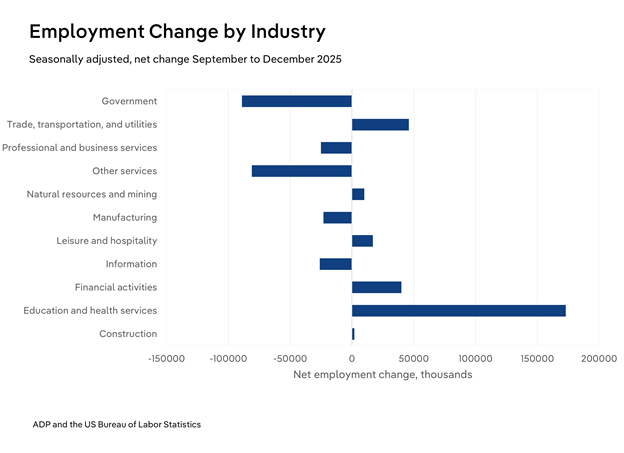
- Private sector employment grew 0.1% from September to December 2025, adding 133,000 jobs and signaling a cautious but improving labor market as employers adjusted to tariff-related cost pressures and an uncertain outlook. Firms focused on cost management and selectively added roles they viewed as most value-additive, which limited broader hiring momentum.
- Health services and utilities industries recorded the largest employment gains, growing by 0.7% and 0.2%, respectively. Health care hiring expanded as providers opened new hospitals and clinics to meet rising demand. At the same time, utilities employment benefited from steady growth in energy services, supporting demand for lineworkers and related roles.
- The unemployment rate edged down only slightly, from 4.4% in September to 4.3% in December, underscoring a labor market that has plateaued rather than strengthened decisively. Employers kept job openings constrained and emphasized retaining existing staff instead of launching broad hiring campaigns, while slower population growth also helped keep jobless rates from rising despite modest job creation.
- Wage growth remained positive but subdued, with average earnings up 2.3% year over year in Q4 2025, supported by statutory minimum wage increases and union bargaining. However, this was the smallest annual wage gain of the year, as smaller compensation budgets set earlier in the year amid past cost concerns left limited room for larger late‑year pay adjustments.
Consumer spending:
- Consumer spending, measured in real personal consumption expenditures (PCE), grew 0.6% from Q3 to Q4 2025, signaling soft but resilient demand as households prioritized essential purchases and pulled back on goods that have become more burdensome at current price levels.
- Durable goods spending was broadly flat, reflecting a weak automotive market—particularly for EVs—after the phaseout of associated tax credits took full effect in late September 2025, eroding sales valuations and buyer interest. Some growth persisted in categories such as recreational goods, vehicles and durable household equipment, driven mainly by higher-income households investing in higher-cost items such as smart-home electronics. In contrast, lower-income households participated less, skewing durable growth toward wealthier consumers and limiting broad-based expansion.
- Nondurable goods spending rose over the quarter, led by gasoline, other energy products and clothing and apparel, even as households contended with cost pressures. Increased road travel and commuting, supported by relatively lower gas prices, sustained energy-related spending. At the same time, apparel outlays were underpinned by wealthier consumers' demand for higher-priced athleisure and lower-income households' use of secondhand apparel markets, allowing both segments to find value at different price points.
- Service spending posted the strongest gains, driven by financial services, insurance, and health care. Rising credit use increased fee-related outlays, while an aging population boosted hospital and medical expenditures, lifting overall service category spending in the quarter.
Inflation:
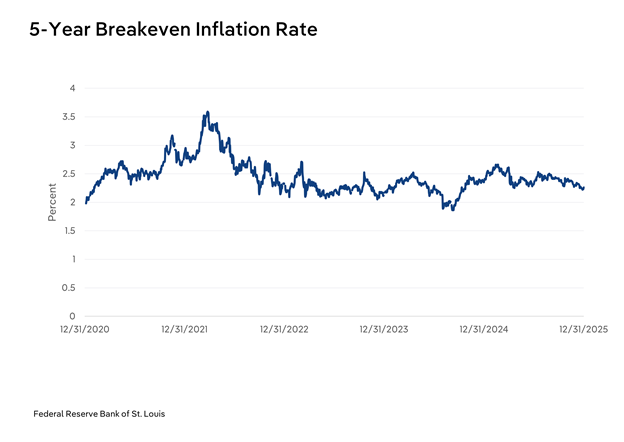
- Inflation rose 2.9% year over year in Q4 2025, edging 0.1% higher than in the prior quarter and remaining above the FOMC's 2.0% target. This persistence reflects ongoing pressure from tariffs, which continue to raise input costs for domestic importers by adding duties to a broad range of goods.
- Energy prices increased nearly 2.5% quarterly for gasoline and related energy products, driven largely by higher heating oil costs. Unexpectedly cold weather boosted demand for home-heating fuels, straining energy infrastructures and pushing year-end price expectations higher.
- Food and beverage prices rose 0.6% over the quarter in a mixed pricing environment. Egg prices, which spiked earlier in the year because of avian flu, began to normalize as flock sizes were rebuilt, but tight cattle inventories pushed beef prices higher, making meat more expensive. These pressures were exacerbated by screwworm infestations and the temporary closure of cattle imports from Mexico in summer 2025, limiting the ability to supplement domestic supply and keeping meat prices—and overall food inflation—elevated.
Residential construction:
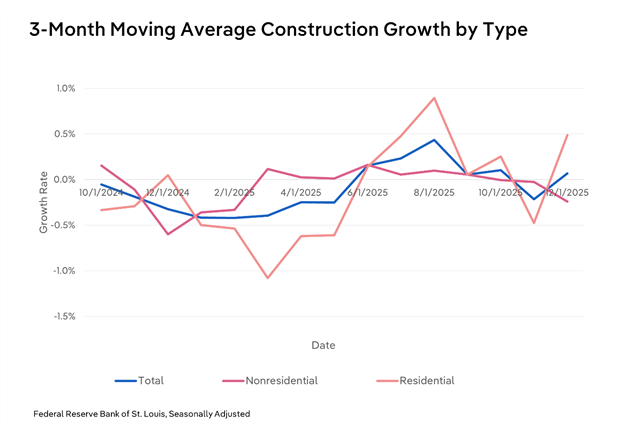
- Residential construction spending grew 0.3% in the quarter, but gains were uneven across regions. Unlike in prior years, when the South led growth on affordability and in-migration, saturation in several Southern markets has eroded their relative appeal, while momentum has shifted toward the Northeast and Midwest, where tighter housing inventories and lower mortgage rates are supporting stronger demand for new construction.
- A lower mortgage-rate environment also supported a rebound in home sales late in the year. Existing home sales rose 4.4% month over month in December 2025 after two months of muted growth, as buyers who had locked in financing earlier in the quarter began to benefit from easing mortgage costs, lifting transaction volumes into year-end.
- By contrast, multifamily construction weakened over the quarter, with a seasonally adjusted 14.6% drop driven in part by a very weak October for new starts. Developers faced growing difficulty securing equity and contended with new or tighter rent controls and lease limitations in some jurisdictions, prompting many to scale back projects and weighing on sentiment toward new multifamily development.
Nonresidential construction:
- Nonresidential construction spending declined 0.3% from September to December 2025, reflecting an uneven environment for construction growth. Some sectors still benefit from strong federal support. In contrast, others face reduced public backing compared with prior years and lending conditions remain tight as banks maintain stricter standards to manage perceived risk in nonresidential projects.
- Data centers were the standout winner of the quarter, posting the strongest investment gains as AI-related demand encouraged developers to accelerate project timelines and start dates. This activity supported both private and public construction spending, making data center projects a key driver of nonresidential growth.
- By contrast, manufacturing construction softened as weaker trade growth for US exports and softer domestic demand led manufacturers to delay or scale back expansion plans. At the same time, they wait to see how tariff policy and the broader economy evolve. The cancellation of several EV and clean energy projects further weighed on activity, as a more skeptical policy environment under the Trump Administration—illustrated by the expiration of key tax credits and the removal of additional incentives under the OBBBA beginning in 2026—has undermined the outlook for new clean energy and advanced manufacturing investments.
Financial markets:
- Following a September cut, the FOMC implemented additional reductions in October and December, bringing the federal funds rate back to late 2022 levels and easing borrowing conditions. These moves reflect the Federal Reserve's effort to support labor market growth after months of stagnant job creation and an unchanged unemployment rate, while still honoring its dual mandate, given that inflation remains above target, and limiting the pace of cuts relative to the Trump Administration's calls for more aggressive easing.
- Equities strengthened in the third and fourth quarters, with the S&P 500 posting gains after a sharp drop earlier in the year tied to Liberation Day tariff shocks. Performance was led by health care and communication stocks, supported by rising valuations for GLP-1 drugs and solid AI-driven demand that buoyed communications names.
- Despite improving US equity performance, a weaker and uneven US economy pushed investors toward foreign securities as a hedge against domestic risks. Net purchases of foreign assets increased over the year as investors looked to protect portfolio value from dollar-linked asset volatility. This pattern highlights investors' desire to balance domestic equity exposure with opportunities abroad that became more attractive in dollar terms as the currency softened.
Risk ratings:
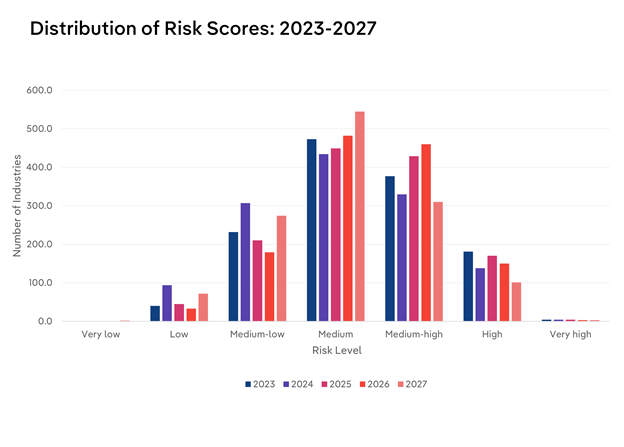
- Aggressive interest rate increases compounded economic uncertainty in 2023. Central banks tightened policy to combat persistent inflation, pushing 43.0% of industries into the medium-high risk category or above.
- Inflation and interest rates both moderated in 2024, with rate cuts beginning in September. Despite this easing, year-over-year price growth remained at 2.9%—above the Federal Reserve's 2.0% target. This sustained inflation limited relief for businesses and consumers, leaving 36.1% of industries at medium-high or higher risk.
- The implementation of tariffs created new economic headwinds in 2025. While selective trade pauses and negotiated deals offered partial mitigation, uncertainty persisted around rising input costs and weakening trade growth. Consumer demand has become increasingly price-sensitive, constraining operators' ability to easily pass through tariff-driven costs without risking volume losses. This pricing pressure and reduced consumer spending appetite increased risk exposure, with 46.1% of industries classified as medium-high or higher risk.
- Although SCOTUS rulings against emergency tariffs initially suggested that some inflationary effects might ease, the Trump Administration responded with a new round of temporary tariffs that will remain in place for much of the year, keeping cost and risk metrics elevated. At the same time, potential USTR investigations into other countries' trading practices could lead to additional tariffs, adding another layer of uncertainty to the economy. Geopolitical headwinds linked to US involvement in the Iran war further threaten energy markets and raise the risk of higher gas prices for consumers and industries alike, contributing to an environment in which an estimated 46.9% of industries are expected to be at medium-high risk or higher in 2026.
Sector rankings:
Construction
This sector will face significant challenges in 2026, even as rising project valuations for data centers create substantial upside for developers that secure these contracts. Data center work will remain at the forefront of nonresidential activity, supported by accelerating AI development, but broad-based construction growth will stay uncertain amid uneven federal support. The Trump Administration's legal disputes over its refusal to release funding for infrastructure and clean energy projects in 2025, along with the effective loss of federal grants for California's high-speed rail project, underscore funding risks for projects deemed low priority or too costly. The OBBBA's removal of tax credits for wind and solar projects will further complicate investment in those segments. At the same time, rising costs and skills gaps tied to retirements and tighter immigration enforcement will strain labor availability and limit capacity utilization, while stable funding for ICE under the OBBBA will keep worksite enforcement elevated and heighten operational risk for contractors that depend on immigrant labor. Home Builders and Heavy-Engineering Construction operators will be particularly exposed as they navigate funding delays, higher materials costs from tariffs and shortages, and persistent labor constraints that pressure profitability.
Information
AI adoption will be a key growth driver in 2026, making AI-enabled software and content more valuable as businesses and consumers integrate these tools into daily workflows and entertainment. Expanding data center capacity will support rising demand for cloud services and infrastructure software, with major providers such as Google benefiting from integrated cloud platforms that power internal AI products and developer tools. These trends will also boost demand for complementary services, including internet service providers and communications carriers, which are accelerating rollouts of 5G-Advanced and Standalone networks in response to prior investment commitments and rising expectations for faster, more reliable connectivity. Together, these dynamics will support strong performance in Software Publishing and Wireless Telecommunications Carriers.
Agriculture, Forestry, Fishing and Hunting
Conditions will remain risky for much of the farming economy in 2026, but some export-related relief is emerging. New agricultural trade agreements with countries such as Indonesia, along with ethanol deals with Guatemala that commit to purchasing US-made ethanol, will support demand for feedstocks such as corn and provide farmers with new outlets for their output. China's decision to continue purchasing US soybeans after earlier threats to restrict imports during tariff disputes offers additional stability for key crop markets. Expectedly low cattle growth in 2026 will likely support higher beef prices and bolster rancher revenues. However, this may be partly offset by higher US beef imports under expanded quotas for Argentina, an increasingly important US ally. Fertilizer costs will remain a major pain point as global demand rises, export controls by key suppliers such as China and Russia persist and natural gas prices stay elevated amid geopolitical tensions, keeping input costs high for many producers. As a result, agriculture will remain one of the riskiest areas of the economy, even as export gains underpin outlooks for industries such as Soybean Farming and Corn Farming.